
 쑥쑥몰
쑥쑥몰

 >
> 


 ←(클릭)http://www.suksuk.co.kr/momboard/list.php?table=BEE_039&search=&sel=&page=1
|
|||||||||||||||


그리고 파닉스에 대해 더 구체적인 자료를 구하시는 분들께 도움될 정보를 링크합니다. 어느 검색창이든, phonics 혹은 '파닉스'라고 입력하시면, 엄청나게 많은 정보를 구할 수 있습니다. 이상 리디아였습니다. |
|||
 http://www.genkienglish.net/phonics.swf 모음과 자음, 그리고 이중음 등의 발음을 들어 볼 수 있어요. 영국 발음이지만, 도움이 될 것입니다.
|
 http://www.sdcoe.k12.ca.us/SCORE/Phonics_Link/FAQ's.html
파닉스에 관해 자주 반복되는 질문을 정리해 두었네요. 한번 읽어 보시고 참고 하세요.
|
||
 http://falcon.jmu.edu/~ramseyil/seuss.htm
언어의 마술사, Dr. Seuss의 자료의 모음 덩어리입니다. 언어 사용 국가 어린이들도 이 책을 좋아하고 많이 접하고 있는 것으로 압니다. 파닉스 교육을 할 때 같이 겸하면 좋은 교재라고 추천하고 싶습니다. 굳이 해석을 하려고 하시는 분들이 많은데, 그냥 시를 읖조리 듯, 자연스럽게 접하는 것이 좋은 방법이라고 봅니다.
|
 http://www.05.co.kr/newfile3.htm http://www.05.co.kr/newfile3.htm
sun soap six seven sink suit sign sandbox sandwich sail 한글로 자세한 설명을 필요로 하시는 분들은 위의 구강도 그림 옆의 주소를 클릭해서 들어가 보세요. 본토인의 정확한 발음과 함께, 유익한 정보 얻으실 것입니다. |
||
 인터넷에서 찾은 사진입니다. 이 그림을 보시면, 아시겠지만, 어린 유아들은 알파벳 소문자, d, b, q, p를 잘 구분할 줄 모릅니다. 여기 수업 장면에서 보면 알겠지만, 아이들이 나이가 좀 있어 보이는데도 이런 수업을 하나 봅니다. 쓰기를 할때도 칸에 맞게 쓰도록 하는 것이 중요하겠지요. 많은 아이들이 j를 거꾸로 많이 쓰기도 합니다. 느리지만, 체계적인 방법이 유아들에게는 중요하다고 봅니다.▶ 인터넷에서 찾은 사진입니다. 이 그림을 보시면, 아시겠지만, 어린 유아들은 알파벳 소문자, d, b, q, p를 잘 구분할 줄 모릅니다. 여기 수업 장면에서 보면 알겠지만, 아이들이 나이가 좀 있어 보이는데도 이런 수업을 하나 봅니다. 쓰기를 할때도 칸에 맞게 쓰도록 하는 것이 중요하겠지요. 많은 아이들이 j를 거꾸로 많이 쓰기도 합니다. 느리지만, 체계적인 방법이 유아들에게는 중요하다고 봅니다.▶
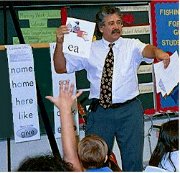
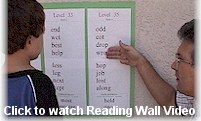
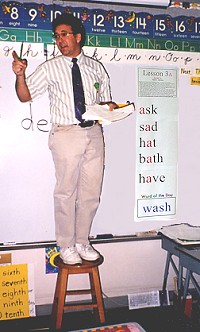
▲집에서도 이런 그림을 붙여 두고 글자를 익숙하게 하는 방법도 좋겠네요. 위의 교실벽에 재미 있는 그림들이 많이 붙어 있지요? 시중에 좋은 플래쉬 카드가 정말 많습니다. 인터넷 서점만 이용하지 마시고, 직접 서점 매장에 가서 골라 보세요. 놀랍니다. 아래 사진들은 www.tampareads.com/에서 가져 왔습니다. 그냥 열정적인 모습이 인상적이어서... 몸을 날리는 모습...크~
|
|||

그리고 보너스!!!
바로 아래의 내용은 캘리포니아주 유치원 교육과정에 나오는 내용인데, 국어지도에 관한 사항이 나와 있네요. 참고 하시기 바랍니다.
http://www.sdcoe.k12.ca.us/SCORE/stand/std.html#KINDLSS
The California Language Arts Content Standards
KINDERGARTEN
READING
1.0. WORD ANALYSIS, FLUENCY, AND SYSTEMATIC VOCABULARY DEVELOPMENT:
Students know about letters, words, and sounds. They apply this knowledge in
reading simple sentences.
Concepts About Print:
1.1 Identify the front cover, back cover, and title page of a book.
1.2 Follow words from left to right and from top to bottom on the printed page.
1.3 Understand that printed materials provide information.
1.4 Recognize that sentences in print are made up of separate words.
1.5 Distinguish letters from words.
1.6 Recognize and name all uppercase and lowercase letters of the alphabet.
Phonemic Awareness:
1.7 Track (move sequentially from sound to sound) and represent the number, sameness/difference, and order of two and three isolated phonemes (e.g., /f, s, th/, /j, d, j/).
1.8 Track (move sequentially from sound to sound) and represent changes in simple syllables and words with two and three sounds as one sound is added, substituted, omitted, shifted, or repeated (e.g., vowel-consonant, consonant-vowel, or consonant-vowel-consonant).
1.9 Blend vowel-consonant sounds orally to make words or syllables.
1.10 Identify and produce rhyming words in response to an oral prompt.
1.11 Distinguish orally stated one-syllable words and separate into beginning or ending sounds.
1.12 Track auditorily each word in a sentence and each syllable in a word.
1.13 Count the number of sounds in syllables and syllables in words.
Decoding and Word Recognition:
1.14 Match all consonant and short-vowel sounds to appropriate letters.
1.15 Read simple one-syllable and high-frequency words (i.e., sight words).
1.16 Understand that as letters of words change, so do the sounds (i.e., the alphabetic
principle).
Vocabulary and Concept Development:
1.17 Identify and sort common words in basic categories (e.g., colors, shapes, foods).
1.18 Describe common objects and events in both general and specific language.
KINDERGARTEN
Students identify the basic facts and ideas in what they have read, heard, or viewed. They use comprehension strategies (e.g., generating and responding to questions, comparing new information to what is already known). The selections in Recommended Readings in Literature, Kindergarten Through Grade Eight
(California Department of Education, 1996) illustrate the quality and complexity
of the materials to be read by students.
Structural Features of Informational Materials:
2.1 Locate the title, table of contents, name of author, and name of illustrator.
Comprehension and Analysis of Grade-Level-Appropriate Text (Kindergarten)
2.2 Use pictures and context to make predictions about story content.
2.3 Connect to life experiences the information and events in texts.
2.4 Retell familiar stories.
2.5 Ask and answer questions about essential elements of a text.
KINDERGARTEN
3.0. LITERARY RESPONSE AND ANALYSIS:
Students listen and respond to stories based on well-known characters, themes, plots, and settings. The selections in Recommended Readings in Literature, Kindergarten Through Grade Eight illustrate the quality and complexity of the materials to be read by students.
Narrative Analysis of Grade-Level-Appropriate Text:
3.1 Distinguish fantasy from realistic text.
3.2 Identify types of everyday print materials (e.g., storybooks, poems,
newspapers,
signs, labels).
3.3 Identify characters, settings, and important events.
WRITING
KINDERGARTEN
1.0. WRITING STRATEGIES:
Students write words and brief sentences that are legible.
Organization and Focus:
1.1. Use letters and phonetically-spelled words to write about experiences, stories, people, objects, or events
1.2. Write consonant-vowel-consonant words (i.e., demonstrate the alphabetic
principle)
1.3. Write by moving from left-to-right and top-to-bottom
Penmanship:
1.4. Write upper- and lower-case letters independently, attending to form and spatial alignment
WRITTEN AND ORAL ENGLISH LANGUAGE CONVENTIONS
KINDERGARTEN
1.0. WRITTEN AND ORAL ENGLISH LANGUAGE CONVENTIONS: Students write and speak with a command of standard English conventions.
Sentence Structure:
1.1. Recognize and use complete and coherent sentences when speaking
Spelling:
1.2. Spell independently using pre- to early-phonetic knowledge, sounds of the alphabet, and knowledge of letter names
KINDERGARTEN
LISTENING AND SPEAKING
1.0. LISTENING AND SPEAKING STRATEGIES: Students listen and respond to oral communication. They speak in clear and coherent sentences.
Comprehension:
1.1. Understand and follow one- and two-step oral directions
1.2. Share information and ideas, speaking audibly in coherent, complete
sentences


 최신
최신 이전
이전

